Pine Heights Alternative School Committee
Missing YouThe Pine Heights Alternative School Committee is a community group campaigning to establish an arts-focused high school in the former Pine Heights School building. Led by Douglas Mastriani, it presents the school as an alternative to an overcrowded, impersonal public-school system and as a way to keep educational and employment opportunities within the community. Its proposal competes directly with Randall Whitehead Sr.’s plan to convert the property into luxury condominiums, making the building a focal point for competing ideas about who the town should serve.
Formation and Educational Vision
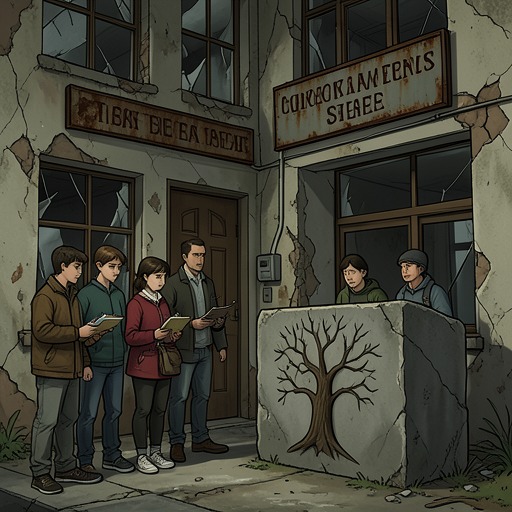
Douglas Mastriani and Tasha Thompkins explain their proposal during a three-block walk to the school: Pine Heights would become an alternative high school rather than another large, impersonal institution like Ernie Pyle High School. The proposed model would let students work at their own pace instead of following a standardized state curriculum. It would emphasize music, drawing, sculpture, drama, and dance, and exclude sports.
The proposal’s emphasis on the arts gives the committee’s plans a practical as well as symbolic dimension. In the same summer, Ruth organizes musicians and actors to bring plays and musicals to inner-city day-care centers and camps, where there are not enough funds to hire certified teachers. Jessica Mastriani initially doubts the value of such work, but comes to recognize its importance. Later, Douglas suggests that Jessica’s work with Ruth makes teaching at the proposed school a plausible future for her. The committee’s educational vision thus connects artistic activity not only to students’ learning, but also to the kinds of opportunities the town might create for young people and teachers.
The Public Hearing and Competing Proposals
At the city council meeting, Randall Whitehead Sr.’s handouts describe a luxury-condominium development with a gym and a coffee shop on the first floor. The proposed complex is presented as suited to the growing number of DINKs—double-income couples without children—who live in town and commute to Indianapolis. The hearing therefore pits a residential development aimed at those prospective buyers against the committee’s plan for a public-serving school.
Douglas asks the council how far its review of the alternative-school proposal has progressed. The audience’s response is mixed: some welcome the idea, while another attendee worries that teenagers will roam the neighborhood. Douglas answers that an alternative school would not mean unsupervised students: teachers would need state certification, and students could not loiter on school grounds after hours. A neighborhood resident objects that alternative schools generally enroll expelled students and troublemakers. Tasha replies that the proposed school would have strict admissions policies and require references.
The discussion exposes how the school is judged through competing assumptions about its prospective students and its effects on the neighborhood. While some residents fear disorder or falling property values, Douglas argues that the town is already losing young people and talented teachers. He says housing costs are pricing young residents out, while overcrowded public schools leave no openings for teachers. In his account, Pine Heights could create local jobs and give teenagers who might feel lost in the large public high school an opportunity to excel.
Leadership and Community Support
The meeting marks a change in how Douglas is seen. Jessica Mastriani remembers him as a boy who kept to himself and came home crying after other children took his lunch money and called him a spaz. Now he is leading the campaign, speaking publicly with a confidence she had not known he possessed. When attendees applaud him, Jessica is moved; the response shows that his case has reached beyond the committee and found support in the room.
The councilperson promises that both the alternative-school proposal and Randall Whitehead Sr.’s condominium plan will receive a thorough review, with a decision expected by the end of the month. The meeting does not itself settle the contest. Douglas remains dissatisfied, believing that Whitehead has persuaded some residents with claims about property values and the prospect of making the neighborhood the Beverly Hills of Indiana.
Funding and Significance
The campaign later becomes part of Jessica Mastriani’s effort to negotiate with Randall Whitehead Sr. She proposes that he abandon his condominium plan and provide a sizable donation toward establishing the alternative school, presenting this as a possible way to keep him out of jail and civil court. Whitehead asks how large a donation she means. The proposed contribution gives the committee a route toward funding, although the evidence does not specify the amount or describe the committee’s subsequent administration of the money.
Douglas is identified as the committee’s head and is expected to receive Whitehead’s check personally. Afterward, he tells Jessica that the town can finally have a school that both parents and students can love and take pride in. Tasha adds that it could be the kind of school Jessica might want to return to as a teacher. The committee’s significance therefore lies not only in its defense of a particular use for the Pine Heights building: its campaign links arts-centered education to local employment, young people’s prospects, and a renewed sense of civic possibility.